

Despite an increasingly challenging external environment, the US economy has continued to demonstrate resilience this year. Heightened policy uncertainty, the escalation of the conflict between the United States and Iran, and the resulting spike in energy prices have weighed on business and consumer confidence, while raising concerns about renewed inflationary pressures and slower economic growth. Against this backdrop, the resilience of the US labour market has become a key determinant of whether the economy can continue to withstand these headwinds and avoid a more pronounced slowdown.
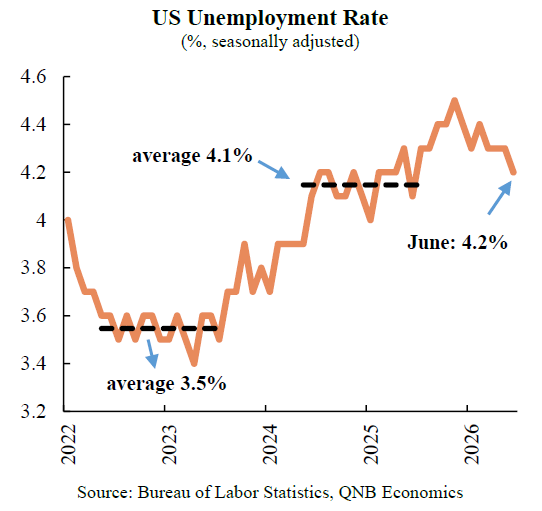
Recent labour market data offer reasons for cautious optimism. While job creation has moderated and hiring has become more measured, a broader set of indicators suggests that labour market conditions remain fundamentally healthy. Importantly, the unemployment rate has remained broadly unchanged from its average level last year, indicating that the moderation in hiring has not translated into a meaningful deterioration in overall labour market conditions. In this article, we discuss three key factors that continue to underpin the resilience of the US labour market and the overall economy.
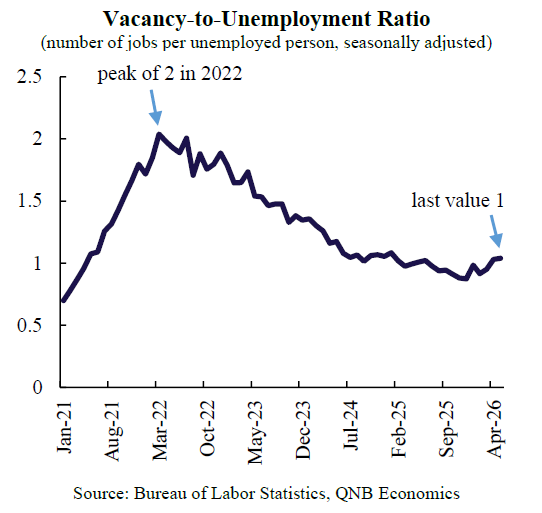
First, labour demand has moderated but remains consistent with a healthy labour market. Job creation has slowed over the past year, while firms have become more cautious in expanding their workforces amid elevated uncertainty and weaker business confidence. At the same time, job openings have continued to decline, bringing the vacancy-to-unemployment ratio – the number of available jobs for every unemployed worker – from a peak of around 2.0 in early 2022 to close to 1.0 in the most recent release, broadly in line with its pre-pandemic average. This ratio is closely monitored by the Federal Reserve as a measure of labour market tightness. A ratio well above one indicates that there are substantially more job vacancies than unemployed workers, often leading to stronger wage pressures, whereas a ratio closer to one suggests a more balanced labour market. Importantly, initial jobless claims and layoff rates remain historically low, indicating that firms continue to retain workers. Taken together, these indicators point to an orderly normalization in labour demand rather than the broad-based deterioration that typically precedes a recession.
Second, wage growth has continued to support household purchasing power. Although nominal wage growth has moderated from the elevated rates observed in recent years, workers’ earnings have generally continued to outpace inflation over the past year, despite a temporary resurgence in price pressures following the energy shock. In other words, wage increases have, on average, exceeded increases in the cost of living, allowing real wages – that is, wages after accounting for inflation – to continue increasing over the past year. As a result, households have experienced sustained gains in purchasing power, helping to support consumer spending, which accounts for around 70% of US GDP. Consequently, stronger household purchasing power continues to underpin domestic demand and reinforce the resilience of the broader economy.
Third, artificial intelligence is beginning to reshape the labour market, but its aggregate impact remains limited. The rapid adoption of AI technologies is changing hiring patterns across a growing number of industries, particularly in occupations involving routine cognitive tasks such as administrative support, customer service and software development. At the same time, demand for workers with AI-related and advanced technical skills has continued to increase. However, despite widespread concerns about job displacement, there is still limited evidence that AI has materially weakened overall labour market conditions. Employment continues to expand, unemployment remains close to levels consistent with full employment, and layoff rates remain historically low. Instead, current evidence suggests that AI is primarily changing the composition of jobs and the skills demanded by employers rather than reducing total employment.
All in all, the recent moderation in the US labour market should be interpreted as a normalization rather than a sign of broad-based weakness. Labour demand has become more balanced, wage growth continues to support household purchasing power despite recent inflationary pressures, and there is little evidence that the adoption of artificial intelligence has materially weakened aggregate employment. As a result, the labour market remains well positioned to support consumer spending, reinforcing the resilience of the US economy.
Download the PDF version of this weekly commentary in English or عربي